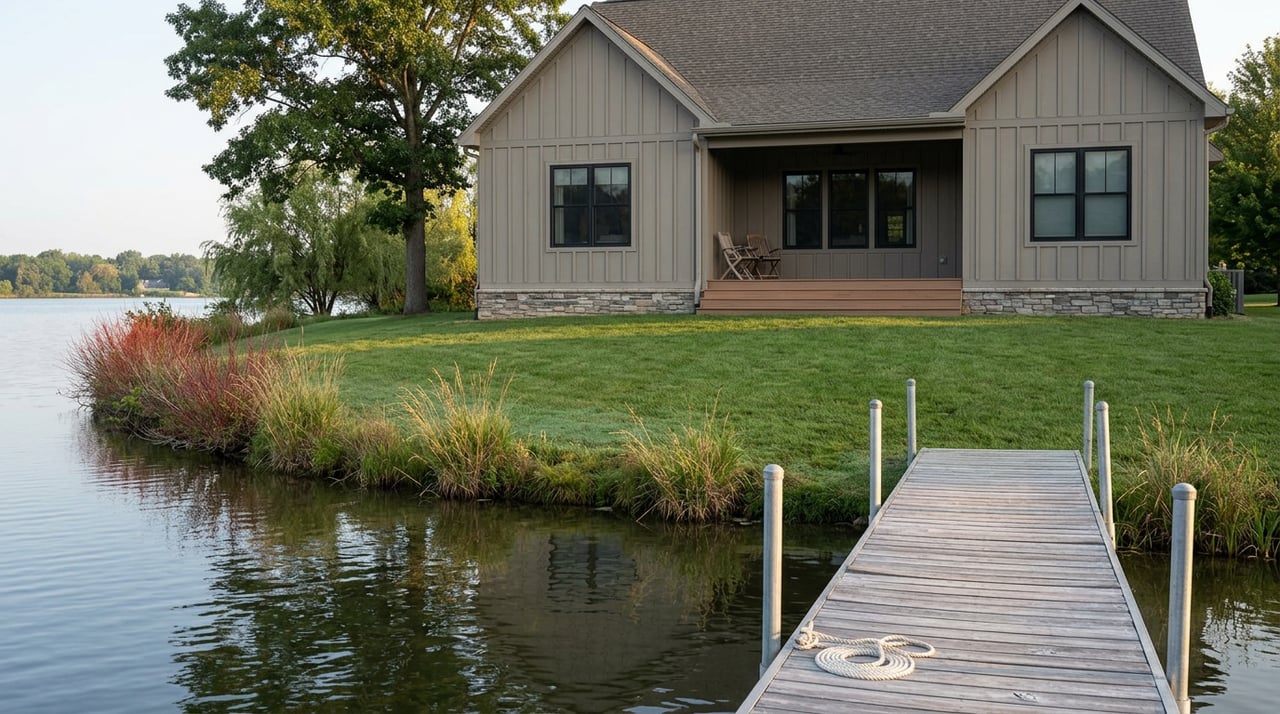
Two homes went up for sale on the Oconomowoc chain of lakes this year. Both sat on roughly the same amount of water. Both had recent kitchen updates and matching asking prices, give or take a few thousand dollars. One had an accepted offer inside three weeks. The other is still sitting.
The difference wasn't the house. It was a folder of paperwork that neither seller thought to pull until a buyer's attorney asked for it.
The document buyers' attorneys ask for before agents do
Wisconsin's DNR draws a hard line at April 17, 2012. Any pier or wharf placed in the water before that date, without a state permit, is grandfathered as what the agency calls a Legacy Pier. It gets to stay exactly as it is, same footprint, same number of boat slips, no permit required. Anything built or substantially changed after that date has to meet current exemption standards or go through individual DNR review.
Here's the part that actually decides how a closing goes: the pier's exemption status can raise a question for a buyer. If a buyer later wants a different pier, something wider, longer, or reconfigured for a bigger boat, they have to requalify under today's rules, not 2012's. A seller who can hand over a clean permit history, or clear documentation that the pier is Legacy-exempt, removes a question mark that otherwise sits on the buyer's side of the table through the entire due diligence period. A seller who can't produces exactly the kind of open item that stalls a closing while everyone waits on a DNR records request.
Why the tape measure matters more than the floor plan
Walk through recent lakefront listings around Oconomowoc and you'll notice something: the headline number almost never lives in the square footage. It lives in the frontage. Listings lead with 50 feet, 61.5 feet, 75 feet, 99 feet, 105 feet, 109 feet, 140 feet of shoreline, because that number, not the bedroom count, is what tells a buyer how much lake they're actually purchasing.
This matters for pricing in a way that trips up sellers who think in square feet out of habit. A smaller house on generous, level, swimmable frontage regularly outperforms a larger house squeezed onto a narrow or steep lot. Statewide guidance on lakefront valuation backs this up in general terms, and it plays out lake by lake here: buyers are pricing the water, then the walls.
That also means two homes with identical listing prices can represent very different deals depending on what's actually buildable within the riparian zone. A DNR-shown exclusive riparian zone, the space where a pier can legally sit relative to the neighbor's, is not something a listing photo communicates. It's something a survey communicates. Sellers who order a current boundary survey showing the ordinary high water mark before listing, rather than after an offer falls through, control that narrative instead of reacting to it.
One lake's slowdown says more than the county average
The general story around Lake Country waterfront is that it moves fast: limited supply, high demand, bidding pressure. That story is true in places and wrong in others, and the gap between the two is exactly why a countywide number is the wrong number to trust.
As of August 12, 2026, Okauchee Lake waterfront told a different story. Ten properties were listed, with a median price of $1,249,500 and an average of $2,091,269. Average days on market sat at 206, a figure that classifies the segment as a buyer's market rather than the seller's stampede the general narrative assumes. That is not a small or noisy sample skewed by one outlier home. It reflects an entire lake segment moving at roughly seven months, not seven weeks.
Compare that to the character of the lakes themselves. Okauchee connects four bodies of water and carries a village atmosphere, with the Okauchee Lake Yacht Club running organized, nationally recognized racing fleets since 1936. That kind of activity level and boat traffic is part of the appeal for some buyers and exactly what others are trying to avoid. Lac La Belle, by contrast, runs quieter: roughly 1,100 acres shared between the city and the Town of Oconomowoc, supporting sailing and fishing without the intensity of some neighboring lakes' public-access traffic. Fowler Lake sits smaller still, at 97 acres, tucked into the heart of downtown, with a 2-mile paved walking loop that puts a lakefront buyer steps from Main Street rather than a boat ride from it.
Three lakes within a few minutes of each other. Three different buyer pools, three different pricing rhythms. A seller working from a single countywide median is working from the wrong map.
What a title company will actually ask for
Before a lakefront listing goes live, a handful of documents save weeks later in the process:
| Document | Why it gets requested |
|---|---|
| Current pier permit or Legacy Pier documentation | Confirms the pier's exemption status and whether it needs DNR review |
| ALTA or boundary survey showing the ordinary high water mark | Provides a shoreline reference point for reviewing the property |
| Lake district or management district disclosures | The Fowler Lake Protection and Rehabilitation District can levy special assessments and issue bonds for lake projects. |
| Recent lake-level or slow-no-wake notices | Shows whether seasonal conditions have affected use or access |
| Shoreline structure permit history (boathouse, seawall, rip-rap) | Helps document the history of shoreline modifications |
None of these are exotic requests. They're standard for waterfront closings across the state. The sellers who assemble them before listing spend that time once. The ones who don't spend it during the buyer's attorney review, on the clock, with a closing date already on the calendar.
The governance nobody mentions at the showing
Lakefront ownership around Oconomowoc comes bundled with layers of local governance that rarely make it into a listing description but absolutely show up in disclosure conversations.
The Fowler Lake Protection and Rehabilitation District holds an annual budget hearing every year. Its 2026 meeting took place August 18 at Oconomowoc City Hall. The district has the power to levy special assessments and issue bonds to finance lake projects, funded by property owners within the district. That's not a hypothetical line item. It's a governance structure that can appear as a recorded assessment or an upcoming one during a title search.
Lake conditions themselves shift with the season in ways that generate real, dated municipal action. In April 2026, after a stretch of heavy rain pushed water levels up, the City of Oconomowoc posted a Slow No Wake order for both Fowler Lake and Lac La Belle, to remain in effect until levels returned within six inches of normal summer level. That kind of order affects boat traffic, staging timelines, and how a property shows during an open house window.
And governance itself can be actively contested. A spring 2026 commentary in the Waukesha County Freeman pushed back on a proposed Lac La Belle Management District ordinance that would cut recreational use on the lake, tying the debate to milfoil harvesting on neighboring Fowler Lake and its effect on water clarity. The piece argued any new restriction "should not be evergreen, but carry an expiration date." Whatever the outcome, the debate itself is evidence that lake rules here are live, not settled, and worth a direct conversation with a seller before a buyer's attorney raises it first.
What this actually means for a seller
None of this is about scaring anyone off a lakefront listing. It's about recognizing that a waterfront sale in Oconomowoc has more moving pieces than a standard suburban listing, and the sellers who get ahead of those pieces are the ones whose closings look like the three-week version, not the still-sitting one.
If a pier needs repair before it photographs well, or a dock needs refinishing to match the price point buyers expect at a given frontage, Compass Concierge can front the cost of that prep work, with payment due at closing rather than out of pocket up front. That's a practical tool for exactly this kind of property, where presentation and documentation both carry real weight.
If you're weighing a sale on Fowler Lake, Lac La Belle, Oconomowoc Lake, or Okauchee, the permit history and district status are worth reviewing before a listing goes live, not after an offer comes in. Head Over Heels For Homes works with sellers across Oconomowoc and the broader Lake Country market on exactly this kind of preparation. Schedule a consultation to walk through what your specific shoreline, pier, and district status mean for pricing and timeline before you list.
A few questions worth answering early
What pier details should I confirm before the house sells? Confirm whether the pier qualifies as exempt, either as a Legacy Pier placed before April 17, 2012, or under current exemption standards. A buyer who wants to build something different later has to requalify under the rules in place at that time.
Does frontage footage or total lot acreage matter more to buyers? In practice, frontage footage tends to lead the conversation. It's the number that shows up first in listing descriptions and the one buyers use to compare properties across different lakes, even when total acreage varies.
Why check on lake district rules during a listing? District activity can matter during a listing period, which is part of why a current disclosure conversation matters before contract, not just at closing.
This article is general information, not legal, tax or financial advice. Consult a qualified professional about your situation.
